Why Hotels Still Read Meters by Hand — and the Cost
Why hotel engineering teams still walk the building by hand — and what it's quietly costing them.

Mattias Nahlin
Chief Strategy OfficerThe checklist isn't the problem. The clipboard is.
Why hotel engineering teams still walk the building by hand — and what it's quietly costing them.
Search "hotel preventive maintenance checklist" and you'll find no shortage of advice. Dozens of templates, work-order apps and tidy PDFs, all promising to keep your property running smoothly. Print the checklist, walk the rounds, tick the boxes, file the readings.
It's good advice, as far as it goes. But it quietly accepts a premise worth questioning: that the data underneath the checklist has to be collected by a person, on foot, one gauge at a time.
For most hotels, it still is. And that single assumption is the source of more cost, risk and missed opportunity than any individual item on the list.
A hotel is a surprisingly industrial building
Guests see lobbies and rooms. Behind that, a mid-size hotel operates with the complexity of a small utility company: incoming water, gas and electricity meters; chillers and air-handling units; circulation and booster pumps; boilers and domestic hot-water systems; pool and spa plant with its own dosing and filtration; storage tanks for water, fuel and chemicals; and environmental conditions across dozens of zones.
Every one of those assets has a value an engineer wants to know — a pressure, a temperature, a level, a runtime, a consumption figure. And in the typical property, the way that data is captured hasn't changed in forty years: someone walks to it, looks at it, and writes it down.
The variety is the trap. There's no single system that reads all of it, because the assets came from different manufacturers across different decades with different displays — analog dials, digital panels, a building management system here, a standalone gauge there. So the lowest common denominator wins, and the lowest common denominator is a human with a clipboard.
What the manual round actually costs
The labor is the obvious cost, and it's real — hours of skilled engineering time spent walking and transcribing rather than diagnosing and fixing. But the labor is the smallest part of it.
The readings are stale before they're filed. A round takes time to walk. By definition the readings can't all be from the same moment — the first gauge was read an hour before the last one. You can't compare them cleanly, and by the time anyone looks at the sheet, the building has moved on.
The gaps are where problems live. A round happens once or twice a shift. Everything between rounds is invisible. A pump that starts cavitating at 2am, a chiller drifting out of spec, a chemical feed running dry — none of it surfaces until the next walk, or until a guest complains, whichever comes first. And the guest usually comes first. The worst version of this is timing: a failure that surfaces during peak occupancy, when the building is full, the team is stretched, and a cold shower or a closed pool turns straight into a review score.
Waste shows up on the invoice, not the dashboard. A steadily climbing water or energy figure is the kind of thing that's obvious in a trend line and invisible in a column of hand-written numbers. Most properties discover overconsumption weeks later, when the bill arrives — long after they could have done anything about it.
There's no single view. Water in one logbook, energy in a spreadsheet, the pool plant in the technician's head. Correlating across them — did that consumption spike line up with the pump fault? — is a manual archaeology project nobody has time for.
None of these are checklist failures. The team can execute the checklist perfectly and still be exposed to every one of them, because the problem isn't discipline. It's latency and coverage — the two things a manual process can never fix no matter how well it's run.
Why "just digitize it" has been so hard
If the answer were simply to install smart meters everywhere, hotels would have done it. The reason they haven't comes down to three real barriers.
Replacement is expensive and disruptive. Swapping working meters and gauges for connected ones means capital cost, downtime and often a shutdown of the very system you're trying to monitor. For a building that can't stop serving guests, that's a hard sell.
Infrastructure is a project of its own. Wired sensors need cabling and power. Networked devices need somewhere to live on the network — and hotel IT, rightly, is wary of putting operational-technology (OT) devices on the guest or corporate network at all.
The assets are too varied for one system. This is the real killer. A solution that handles your electricity meters won't touch your pool dosing or your pump vibration. Cover the whole building and you're integrating four or five systems — which is how you end up back at the clipboard as the only thing that spans everything.
So the manual round survives not because anyone defends it, but because every alternative has historically asked the hotel to rip something out, run cable, or buy a different system for each asset type.
The shift: read what's already there
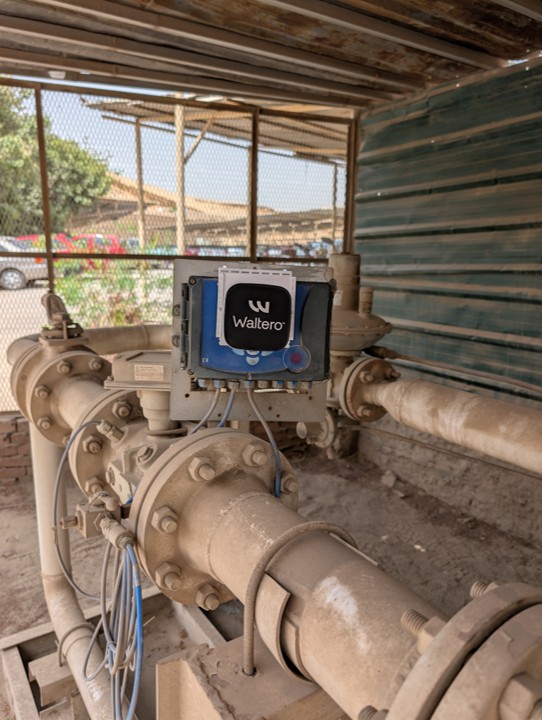
The premise worth overturning is the one buried in the checklist — that a person has to be the sensor. They don't. The gauge already shows the value; the meter already displays the reading. What's been missing is a way to capture that value without replacing the asset or wiring the building.
That's the approach Waltero takes, with two parts that do distinct jobs. The hardware is the W-Sensor: a battery-powered device that clamps onto the meter, gauge or display you already have. Its camera sees what an engineer would see, and edge AI on the sensor converts that image into a single data value on the spot. Only that number leaves the device — never an image, never a video stream. That last point matters more to hotel IT than anything else on the spec sheet: the camera looks at a meter in a plant room, not at people or guest spaces, and because it sends a handful of digits rather than footage, it puts no strain on bandwidth and gives security teams nothing sensitive to worry about. For rotating equipment like pumps, the same sensor family listens instead of looks, picking up the sound and vibration signature that reveals bearing wear or cavitation early.
Because it reads the existing asset, there's nothing to replace and nothing to shut down. Because it's battery-powered with its own cellular uplink, there's no cabling and it doesn't have to touch the hotel network at all — though it can use the property Wi-Fi where that's preferred. And because the same sensor family spans analog dials, digital panels, rotating machinery and water chemistry alike, one approach finally covers the whole building — the thing no system could do before.
That's the hardware half. The software half is Mimir, the platform every W-Sensor reports into. Readings land there every hour — synchronized, so for the first time the numbers are actually comparable across the property. Set a threshold and an out-of-range value raises an alarm the moment it happens, not on the next round. Drill into a trend, export to Excel, or pull it via API into whatever you already use.
From walking rounds to acting on alerts
This isn't theoretical. At the Marriott Mena House in Cairo, the engineering team had been collecting meter readings by hand — slow, and never captured exactly on the hour. W-Sensors now read the existing meters and send hourly data to Mimir, with no replacement and no rewiring.
As their Assistant Director of Engineering, Peter Michel, put it: the data is now more accurate than the manual rounds delivered, precisely because every reading comes in on the hour — something a walk can never do, since the walk itself takes time. The team's day shifted from walking the building to look for problems, to acting on alerts when the building flags them.
That's the real prize. Not a tidier checklist — a different operating model, where the building reports its own condition continuously and your engineers spend their expertise on the things only a human can do.
The checklist still matters
To be clear, preventive maintenance discipline isn't going anywhere, and the checklists the rest of the internet will sell you aren't wrong. The point is narrower: the manual data collection underneath the checklist is a solved problem, and most hotels are still paying the full price of not having solved it — in stale data, blind spots between rounds, late-caught waste, and skilled hours spent transcribing dials.
The clipboard did its job for forty years. It's just no longer the only thing that can span every asset in the building.
Waltero builds clamp-on, vision-AI sensors that digitize existing meters and assets for water utilities, district heating and hospitality — no replacement, no cabling, no IT dependency. See how it works for hotels →
Relevant to your operations?
Talk to us about how we can help you increase control while saving money and trouble
%3Aformat(webp)&w=3840&q=75)


