McKinsey's Tech Trends 2026: the physical layer is the new bottleneck
McKinsey's new tech outlook says innovation has moved off the screen and into the physical world. From where we sit, next to pumps, pipes and meters, that's exactly where it gets stuck.

Mattias Nahlin
Chief Strategy OfficerEvery autumn McKinsey publishes its Technology Trends Outlook, and this year I couldn't help thinking I need to write this post to share a Waltero perspective, already from the first paragraph.
The technology story of 2026, McKinsey writes, has "moved off the screen and into the physical world." Power grids, data centers, robots, satellites. Real things, made of steel and concrete.
That's good news for anyone who works with infrastructure. It's also a warning. Because if you read the report's 14 trends from our side of the table - next to utilities, district heating operators and industrial sites - one pattern stands out. The digital layer is racing ahead. The physical layer is what's holding everything back.
Here's what I took from it.
You can't build your way out of the grid problem
Energy and sustainability technologies attracted more investment than any other trend in 2025, over $194 billion. Yet the report is sobering about where that money gets stuck. It's not generation anymore. It's the grid. According to the IEA figures McKinsey cites, more than 2,500 gigawatts of energy projects are waiting in connection queues worldwide, and transformers can take more than two years to arrive.
Water and district heating look much the same. Networks built over 50 years can't be rebuilt in one investment cycle. New pipes and plants will come, but slowly, and on budget timelines rather than software timelines.
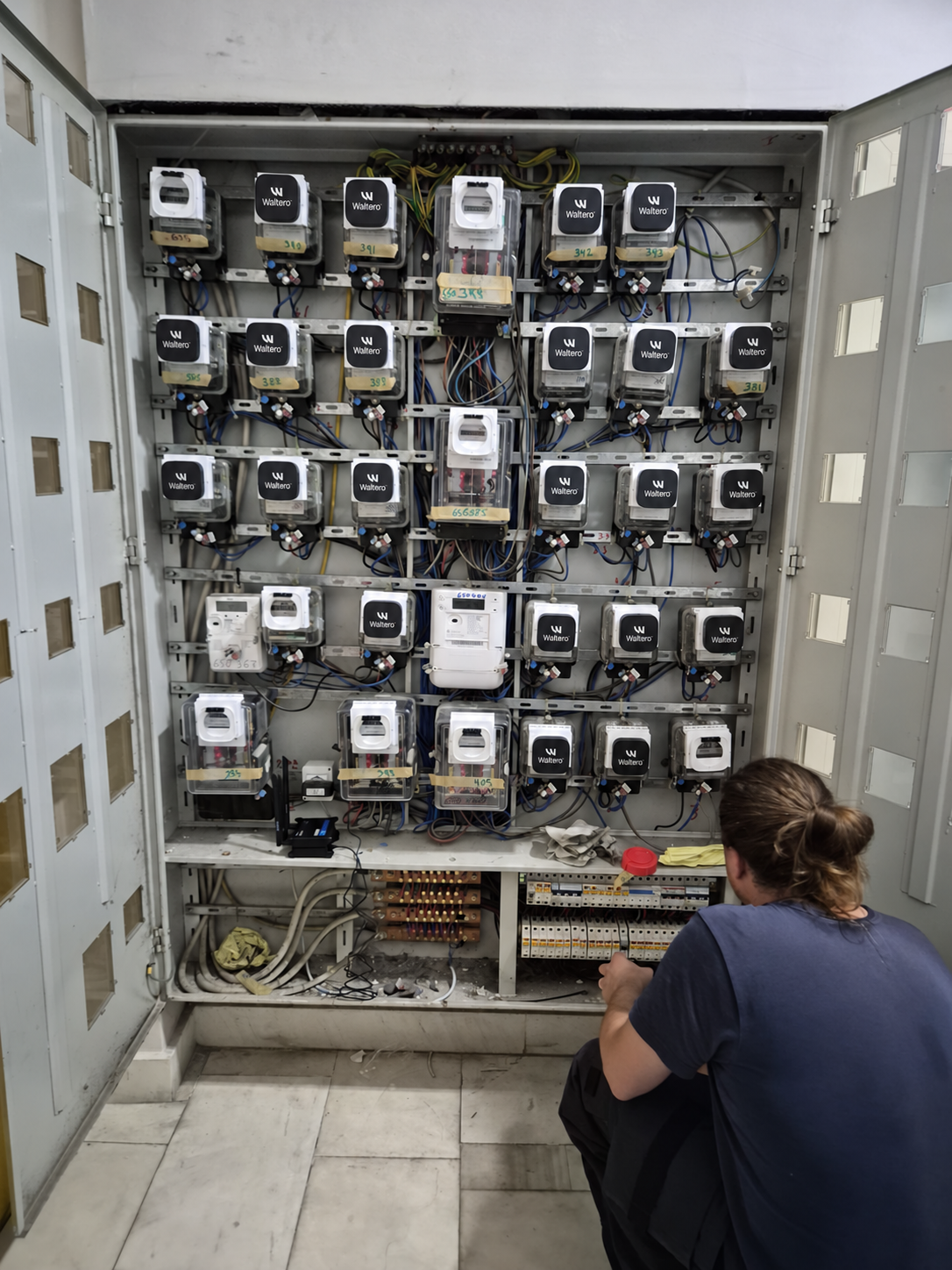
So what do you do in the meantime? The quickest capacity you can add is knowing what's happening in the network you already have. Most of it is already instrumented. There are meters, pressure gauges and level indicators everywhere - they just aren't connected to anything. Someone drives out, reads them and writes the number down.
McKinsey points in the same direction. It lists digital energy systems - forecasting, digital twins, automated dispatch - as a core technology, and notes that measurement and reporting are moving from manual audits to automated, sensor-based systems. All of that sits on top of one boring requirement: reliable data from the field.
Connectivity is no longer the hard part
The report describes connectivity as becoming "less of a utility and more of a strategic enabler." Low-power IoT networks are explicitly part of that trend, and utilities are named among the operators most likely to pay for dedicated, reliable connections. Satellite links are starting to fill the remaining gaps, as a complement to terrestrial networks rather than a replacement.
Ten years ago a pump station in a forest or a valve chamber two meters underground was effectively offline. Today a battery-powered sensor with its own cellular uplink can report from almost anywhere, without a cable and without touching the customer's IT network.
That shifts the question. Coverage is mostly solved. Deciding what to measure, and trusting the reading when it arrives, is where the real work is.
AI agents need something to look at
Agentic AI is one of the fastest-growing trends in the report by hiring - job postings rose more than ninefold from 2024 to 2025. But McKinsey is refreshingly honest about results: only 37 percent of organizations see any EBIT impact from their AI programs so far. And it names integration with legacy systems as "an emerging bottleneck."
We see this every week. An AI tool can draft a maintenance plan or spot an anomaly in seconds. It can't do either for a pump it can't see. In most utilities the most important operational data still lives on an analog dial, in a technician's notebook or in a system nobody ever connected.
Before infrastructure can get intelligent, it has to become readable. That means structured, time-stamped field data, available through open interfaces that both people and software can use.
It also means keeping people in charge. The report notes that European organizations are adopting agentic AI more cautiously than the US, citing regulation, governance and accountability. Some see that as Europe falling behind. For critical infrastructure I think the caution is right. Let AI surface deviations and trends, and let the operator decide what to do about them.
Every connected asset is part of the attack surface
The cybersecurity chapter makes uncomfortable reading. More than three-quarters of vulnerabilities are now classed as zero-day, meaning they're exploited before anyone has disclosed them. AI is shrinking the time between discovery and attack to almost nothing. McKinsey specifically calls out connected devices, operational technology and machine-to-machine traffic as things that now have to be secured at enterprise scale.
For utilities, that should shape how monitoring is designed. A sensor network is only an asset if it doesn't open a door into the process it watches.
This is one of the reasons we built the W-Sensor the way we did. It reads the gauge or meter from the outside, and its edge AI turns the image into a single value on the device. Only that number leaves the sensor - never an image - over its own cellular connection, so it never sits on the operational network. As one McKinsey partner puts it, trust "belongs in the value case, not just the risk register." Agreed.
None of this is new, by the way
Reading the report, I kept thinking of a book I read a while back: David Edgerton's The Shock of the Old. His argument is that the technologies society actually runs on are mostly old ones, kept alive by maintenance and adaptation, while we talk almost exclusively about the new. McKinsey's 2026 outlook is, in a way, the consulting world arriving at the same place. I wrote a separate review of the book and what it means for IoT and retrofit: Book review: The Shock of the Old.
So what should infrastructure operators do?
McKinsey closes its energy chapter by saying the leaders will be "those who execute across technology, infrastructure, and policy at the same time." Execution, not invention, is the edge now. In practice I'd boil it down to this:
Start with what you already have. Connect the meters, gauges and indicators already installed before planning new instruments. It's the fastest, lowest-risk way to see your network in near real time.
Build a data layer that's ready for AI, not dependent on it. Good field data with open interfaces lets you add analytics and AI when they prove their worth, instead of betting the network on them today.
Make security a design requirement, not an add-on. Choose monitoring that stays outside your control systems.
To be fair, some assets do need replacing, and no sensor fixes a pipe that's falling apart. But replacement takes decades. Visibility takes weeks.
We've seen what that looks like in practice. At VA SYD, remote camera monitoring of inlets cut routine site inspections by 66 percent in the first phase alone. At the Marriott Mena House in Cairo, the engineering team went from walking the building with a clipboard to acting on hourly alerts (we wrote about that here).
The physical layer is the bottleneck. It's also where the opportunity is. If you're curious what your existing assets could tell you, get in touch - we'd love to hear what you're working on.
Relevant to your operations?
Talk to us about how we can help you increase control while saving money and trouble
%3Aformat(webp)&w=3840&q=75)


